Why a 24-hour delay on a commercial roof leak can double your interior repair costs
Why a 24-hour delay on a commercial roof leak can double your interior repair costs
In the world of commercial real estate and facility management, time is the most expensive commodity. When a drop of water hits a desk in a high-rise office or a pallet in a distribution center, a silent stopwatch begins. As an independent commercial roof consultant, I have spent decades helping facility managers navigate the complexities of building envelopes. My name is David D. Rich, and throughout my career, I have witnessed a recurring, painful trend: the $500 minor repair that transforms into a $50,000 catastrophe because of a 24-hour hesitation.
A commercial roof leak is never just a “drip.” It is a symptom of a systemic failure that, if left unaddressed for even one business day, triggers a cascade of financial and structural consequences. In this industry, we often discuss the “3-5x Rule.” This rule of thumb dictates that emergency repairs – those performed under duress when a leak is active – typically cost three to five times more than planned maintenance. However, the true cost isn’t just the invoice from the roofer; it’s the exponential growth of interior damage, mold remediation, and business interruption. If you are managing an emergency roof leak for an office building, the clock is your greatest enemy.
The Physics of a Flat Roof Leak: Why Gravity is Only Half the Problem
To understand why costs escalate so quickly, one must understand the anatomy of a modern commercial roof. Unlike residential sloped roofs where water sheds quickly, commercial systems – typically TPO (Thermoplastic Polyolefin), EPDM (Ethylene Propylene Diene Terpolymer), or BUR (Built-Up Roofing) – are designed to manage water on a low-slope or flat surface. When a breach occurs in the membrane, gravity is only the secondary force at play; the primary issue is horizontal migration.
On a flat roof, water doesn’t always fall straight down. It travels. It finds the path of least resistance across the top of the insulation boards, often traveling 20 to 50 feet away from the actual membrane puncture before finding a seam in the insulation or a gap in the structural deck to enter the building. This is why finding the source of a TPO roof leak can be so frustrating for inexperienced maintenance crews. By the time you see a drip in the ceiling, the water has likely already saturated a massive “footprint” of insulation.
This leads us to the “24-72 Hour Window.” Most commercial roofs utilize polyisocyanurate (polyiso) or mineral wool insulation. These materials are highly effective for thermal resistance but act like a high-density sponge when the building envelope is breached. Within the first 24 hours, the insulation becomes saturated. Once saturated, it loses its R-value and structural integrity. Furthermore, if the membrane is mechanically attached, the moisture can begin to affect the fasteners. Understanding the roofing nail pattern required for high-wind zones is critical here; if the substrate or the fasteners are compromised by moisture, the roof’s ability to withstand wind uplift is severely diminished, potentially leading to a total blow-off in the next storm.
The Financial Breakdown: Why Costs Double in 24 Hours
The financial multiplier of a roof leak is aggressive. Let’s look at the timeline of a typical leak escalation to see how a simple $300 fix today can escalate into a $3,000 repair within 30 days – and why the first 24 hours are the most critical.
Phase 1: The Initial Breach (Hour 0-12)
In the first 12 hours, the leak is usually a “clean” breach. A small puncture from flying debris or a failed seam in the parapet wall flashing allows water to enter. At this stage, an Emergency Commercial Roofer can often perform a “probe and patch.” The cost is minimal – usually a service call fee and an hour of labor. The insulation is damp but not yet compromised.
Phase 2: The Saturation Point (Hour 12-24)
Between 12 and 24 hours, the water has begun to spread laterally. The insulation boards are now absorbing the moisture. Once polyiso insulation is saturated, it cannot be “dried out” effectively while in place. According to the National Roofing Contractors Association (NRCA), wet insulation must be removed and replaced to maintain the thermal integrity of the system and prevent the growth of organic matter. Now, your $300 patch has turned into a $1,500 project involving the removal of the membrane, cutting out the wet insulation, replacing it, and heat-welding a new patch over the area.
Phase 3: Structural and Interior Damage (Hour 24+)
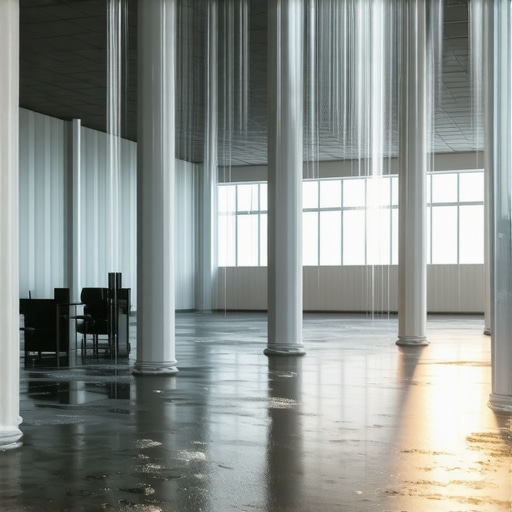
After 24 hours, the water has reached the structural deck. If you have a steel deck, the oxidation process (rusting) begins almost immediately. If you have a concrete deck, the water can migrate through the slab, potentially affecting electrical conduits embedded within. Internally, the water has now soaked the ceiling tiles, run down the wall cavities, and begun to pool on the floor or, worse, on expensive office equipment. At this point, you are no longer just paying for a roof repair; you are paying for a water damage restoration project. This is where the 3-5x cost multiplier becomes a reality.
When you are faced with these escalating costs, it is vital to keep a close eye on your budget. For instance, when the repair becomes a partial replacement, you should work to strip the dump-fee markup from your roof replacement quote to ensure you aren’t being overcharged during the emergency phase.
Interior Collateral Damage: Beyond the Ceiling Tile
The most significant cost of a 24-hour delay often isn’t on the roof at all – it’s what lies beneath it. For an Emergency Roof Leak for Office Building managers, the interior collateral damage can be devastating. Modern offices are filled with high-end electronics, server racks, and sensitive documents. A single leak over a server room can result in data loss that costs millions.
Furthermore, we must discuss the “M-word”: Mold. According to the Environmental Protection Agency (EPA), mold can begin to colonize on damp surfaces within 24 to 48 hours. If water leaks into a wall cavity and stays there because the roof wasn’t repaired immediately, you are creating a perfect incubator for mold. Mold remediation is significantly more expensive than roofing. While you might be looking at how to accurately estimate costs for home improvements or commercial asset management, mold remediation often requires specialized contractors, air scrubbing, and environmental testing, which can easily add $10,000 to $20,000 to the bill.
Inventory loss is another factor. For retail or warehouse facilities, a leak that goes unchecked for 24 hours can ruin thousands of dollars in product. Unlike a roof, which can be repaired, inventory is often a total loss, and insurance claims can take months to process, impacting your cash flow in the interim.
Operational Risks and Liability
Beyond the physical damage, there are the “soft costs” of a commercial roof leak. These are the risks that don’t show up on a repair quote but hit the bottom line just as hard.
- Slip-and-Fall Liability: A leak that creates a puddle in a common area or hallway is a massive legal liability. If an employee or customer slips, the resulting lawsuit will dwarf the cost of even the most expensive roof replacement.
- Employee Productivity: If a section of the office is cordoned off due to a leak, or if the sound of dripping water is distracting a team, productivity drops. In a high-output environment, a 10% drop in productivity across 50 employees for three days is a significant financial loss.
- HVAC Efficiency: When roof insulation gets wet, it loses its ability to resist heat transfer. This puts an immediate strain on your building’s climate control. This is often linked to the HVAC Sizing Mistake That Fails the Energy Audit; if your insulation is compromised, your HVAC system will run longer and harder to compensate, leading to higher utility bills and premature equipment failure.
Industry data suggests that the average business interruption cost for a medium-sized commercial entity ranges from $5,000 to over $100,000, depending on the severity and the area affected. This is why flat roof maintenance isn’t just a building expense – it’s a business continuity strategy.
Identifying the Culprit: Common Failure Points
When you call in Commercial Roofers for Leaks, they will typically look at a few “usual suspects.” Understanding these can help you communicate more effectively with your contractor.
- Parapet Walls and Coping: The junction where the roof meets the wall is the most common failure point. If the flashing has pulled away or the caulking has cracked, water will pour directly into the wall cavity.
- Roof Drains and Scuppers: If a drain is clogged with debris, water will back up. On a flat roof, this “ponding water” creates immense pressure. A single inch of water weighs approximately 5 pounds per square foot. If your roof has 2,000 square feet of ponding water, that’s an extra 10,000 pounds of stress on your structure.
- HVAC Curbs: The flashing around heavy rooftop units can fail due to the vibration of the machinery. This is another reason why building envelope integrity is a holistic discipline. Just as why your foundation wall needs waterproofing even in dry climates, your roof penetrations need constant vigilance regardless of the local weather patterns.
Conclusion: The Proactive Strategy
The math of commercial roofing is simple but brutal: Delay equals Debt. A 24-hour delay in addressing a commercial roof leak is a gamble where the house always wins. By the time you see the evidence of a leak inside your building, the damage to the roof’s core components is already well underway.
To protect your asset, you must move from a reactive “break-fix” mindset to a proactive inspection-based strategy. Regular commercial roof inspections – at least twice a year – can identify the minor cracks in flashing or the small punctures in a TPO membrane before the next rainstorm turns them into an emergency. If you are currently dealing with a leak, do not wait for the weekend to end or for the “next budget cycle.” Contact a professional consultant or a trusted team like Peak to Peak Roofing & Exteriors immediately. Stopping the water within the first 24 hours is the single most effective way to protect your building, your tenants, and your bottom line.