The ghost in the attic
The smell of pencil lead hangs heavy in my office today, mixing with the scent of a brewing afternoon rain rolling off the Front Range. You look at a roof and see shingles; I see a structural envelope under siege by the erratic violence of Colorado weather. In the old days, we trusted a man with a ladder and a chalk stick to tell us if a home was sound, but those days are as dead as the hand-drawn blueprints in my flat files. If you are sitting in a kitchen in Wash Park or Park Hill looking at a roofing quote that was scribbled after a twenty-minute walkabout, you are likely holding a document full of expensive lies. The 2026 reality of Denver roofing demands a digital twin. Editor’s Take: A 3D storm audit is the only way to capture the volumetric data required to bypass insurance friction and ensure structural integrity in a high-wind environment. Direct answers are rare in this industry, but here is one: a standard manual inspection misses nearly thirty percent of peripheral shingle fractures that lead to ice damming during our brutal freeze-thaw cycles. You need precision, not a guess from a guy who smells like a ladder rack.
Where the tape measure fails
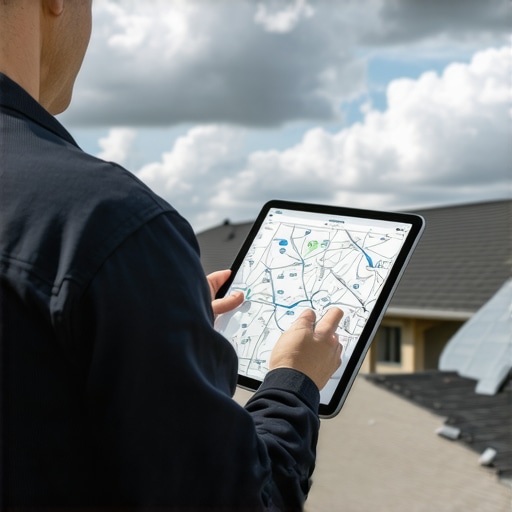
Modern roofing is a game of millimeters and material science. When a storm rips through the I-25 corridor, the damage is rarely uniform across the pitch. We now use LIDAR and aerial photogrammetry to build a three-dimensional model of the structure before a single tool is lifted. This isn’t about being fancy; it is about the physics of the load. Observations from the field reveal that manual measurements often ignore the slight sagging in older rafters found in homes near Sloan’s Lake, leading to improper drainage calculations. By using a 3D storm audit, a contractor can simulate how water will shed during a heavy June downpour. This data allows for the exact calculation of flashing requirements and ridge vent placement. It is the difference between a roof that lasts fifteen years and one that fails when the next golf-ball-sized hailstone decides to visit from the clouds. We are mapping the grain of the house itself. It is a digital autopsy of a storm’s impact. The relationship between the pitch, the soffit intake, and the exhaust isn’t just a checklist; it is a breathing system. If the data is wrong at the start, the build is a failure waiting to happen. Most adjusters are still using software from the early 2000s that assumes every roof is a flat plane, but we know better. We see the curves and the stress points that the naked eye ignores in the midday sun.
[IMAGE_PLACEHOLDER]
Living in the path of the mountain wind
Denver isn’t just another city; it is a high-altitude laboratory for material degradation. Our proximity to the mountains creates a venturi effect that can peel back poorly installed shingles like the skin of an orange. In neighborhoods like Cherry Creek or the Highlands, the local building codes have tightened significantly regarding wind uplift ratings. A 3D audit provides the empirical evidence needed to prove that a simple repair won’t suffice when the structural decking has been compromised by repeated micro-bursts. I have stood on roofs in Littleton where the owner was told they just needed a few patches, only for our scans to show a three-inch deflection in the ridge board that was invisible from the street. Colorado’s Title 10 regulations regarding insurance fair claims practices mean that having a digital record of your roof’s geometry can be the smoking gun in a disputed claim. We aren’t just looking for dents in the metal; we are looking for the structural memory of the wood. The way the sun hits a south-facing slope in Denver causes faster thermal expansion than in most other states. This creates a specific type of wear that global roofing blogs never mention. You have to be here, breathing this thin air and watching the shadows stretch across the shingles, to understand why a flat quote is an insult to the architecture.
The insurance adjuster’s blind spot
The messy reality of the roofing business is that the insurance company is not your architect. They are looking for reasons to say no, and a grainy photo from a smartphone is their favorite piece of evidence to ignore. When we present a 3D storm audit, we are handing them a mathematical proof that is difficult to litigate against. Standard advice tells you to get three quotes and pick the middle one, but that is a recipe for a leaking skylight in three years. Most experts are lying to you when they say a visual inspection is enough. Visuals are subjective; geometry is absolute. I have seen countless homeowners in Arvada get stuck with a five-figure bill because their initial inspector didn’t account for the waste factor on a complex hip roof. The 3D model eliminates this friction by providing a precise cut-sheet for the materials. It prevents the ‘oops, we need more shingles’ conversation that usually happens on the second day of a job when the yard is already a mess. If your roofer isn’t talking about the ‘point cloud’ of your property, they are still living in 1995. They are trying to build a modern shield with a medieval mindset. You deserve the data that matches the investment you are making in your home’s future.
A future built on digital twins
The shift from ‘eyeballing it’ to digital modeling is the most significant change I have seen in decades of observing the city’s skyline. Why is a 3D audit better than a drone photo? Because a photo lacks depth. A 3D model allows us to rotate the house, look under the eaves virtually, and identify where the ice dams of 2027 will likely form. Is a 3D audit more expensive? Usually, the cost is absorbed into the project because it saves so much in material waste and labor errors. What happens if my insurance denies the 3D data? You use it as the basis for an appraisal process, which is a legal right in most Colorado policies. Does this work on flat roofs in LoDo? Absolutely, and it is even more critical there where ponding water is the silent killer of masonry. Can I get a 3D audit after the roof is already replaced? It is better as a baseline, but even a post-install scan can verify that the work was done to the specified pitch. The old guard will tell you this is overkill. They said the same thing about indoor plumbing and reinforced concrete. They were wrong then, and they are wrong now. The rise of digital twins in residential construction is not a trend; it is the new standard of care.
The blueprint for survival
As the sun sets and the sky turns that bruised purple unique to a Denver evening, I think about the houses that won’t survive the next decade. They are the ones built on guesses and ‘good enough’ estimates. Your home is a series of interconnected systems, and the roof is the most stressed member of that family. Don’t settle for a quote that treats your property like a commodity. Demand a 3D storm audit that respects the lines, the angles, and the history of your roof. It is time to stop guessing and start measuring with the precision that the Mile High City demands. Your quote should be a blueprint, not a post-it note. Secure your structural integrity today by insisting on the technology that sees what the human eye misses. Your future self, standing dry and warm during a January blizzard, will thank you for the foresight.