The Specific Safety Rule That Most Emergency Garage Door Repairs Must Follow
The Specific Safety Rule That Most Emergency Garage Door Repairs Must Follow
Imagine the scene: It is 2:00 AM on a Tuesday in San Jose. You are already running late for an early morning flight out of SFO, or perhaps you are returning home from a late shift. You press the button on your remote, and instead of the familiar hum of your garage door rising, you hear a deafening “crack” like a gunshot. The door jerks, tilts at a precarious angle, and refuses to move. You are stuck. In this moment of desperation, you search for emergency garage door repair, hoping for a technician who can perform a quick miracle and get you on your way.
As an expert technician who has spent years servicing bay area garage doors, from the quiet suburbs of Burlingame to the bustling streets of San Jose, I have seen this scenario play out hundreds of times. Homeowners often view an emergency as a situation where “any fix is a good fix” as long as it works immediately. However, there is a critical misunderstanding at play. In the world of professional contracting, an “emergency” does not grant a technician a license to bypass safety codes. In fact, many urgent garage door repair situations actually trigger mandatory safety upgrades that homeowners don’t expect.
My name is Lynn Lenardon, and today I am going to pull back the curtain on the “secret” rules that govern our industry. Whether you need to fix garage door issues or are looking into a full replacement, understanding these rules is vital for your safety and your legal liability. Garage door safety is as critical as Understanding Permit Processes for New Building Projects; it is the foundation of a secure home.
II. The Federal Foundation: UL 325 Entrapment Protection
The most fundamental rule governing any garage door repair is the federal standard known as UL 325. While it sounds like technical jargon, it is the single most important safety regulation in the industry. Since 1993, federal law has mandated that all residential garage door openers (GDOs) manufactured or installed in the United States must include a primary and a secondary entrapment protection system.
Before these regulations were strictly enforced, garage doors were essentially heavy, motorized guillotines. The “top story of the decade” in the early 90s within the construction industry was the tragic rise in entrapment deaths involving children. These accidents occurred when a door would close on a person who was unable to trigger the motor’s internal resistance sensor. UL 325 changed everything by requiring secondary sensors – most commonly the “photo-eyes” or infrared sensors you see at the base of your door tracks.
When I am called out to fix garage door opener systems in older Bay Area homes, I often encounter units installed prior to 1993 that lack these sensors. Here is the hard truth: a licensed, professional technician cannot legally repair an opener that does not meet UL 325 standards without bringing it up to code. If your motor is burnt out and it’s a 1990 model without photo-eyes, I cannot simply swap the motor and leave. The law requires that the entire system be brought into compliance or replaced with a modern, safe unit.
UL 325 also dictates the “reversal test.” If a garage door is closing and hits an object as small as a 2×4 piece of wood laid flat on the ground, it must reverse within two seconds. During an emergency garage door repair, we aren’t just looking at what broke; we are checking the entire safety ecosystem. Bypassing these sensors to “save time” is not just a violation of my ethics; it is a violation of federal safety standards that keep your family safe.
III. The California Mandate: SB-969 and Battery Backups
While UL 325 is the federal floor, California has raised the ceiling with Senate Bill 969 (SB-969). This is the “specific rule” that catches most Bay Area homeowners off guard during an urgent garage door repair. Since July 1, 2019, California law has required that every garage door opener sold or installed in a residential residence must be equipped with a battery backup.
The genesis of this law was not bureaucratic red tape; it was born out of the devastating wildfires that have plagued our state. During the 2017 North Bay fires, several individuals tragically lost their lives because they were unable to open their garage doors manually when the power went out. Garage doors are heavy – often weighing between 150 to 400 pounds. Without the assistance of the opener or a perfectly balanced spring, many people, especially the elderly or those with physical limitations, cannot lift them. When the power grid fails, a standard opener becomes a lock that traps you inside.
In the Bay Area, where PG&E Public Safety Power Shutoffs (PSPS) have become a seasonal reality, SB-969 is a literal lifesaver. If you call me for a garage door opener repair and I determine that your motor is dead and needs replacement, I am legally prohibited from installing a model without a battery backup. Even if you want the “cheapest option,” I must follow the law. This is a mandatory safety upgrade that applies to all new installations and replacements. Navigating these rules is very similar to Navigating Permit Requirements for Additions in 2025 – the regulations are there to ensure that the structure remains functional during a crisis.
The battery backup ensures that even when the lights go out, your door will still operate for approximately 50 cycles over a 24-hour period. This gives you the peace of mind that you will never be “trapped” in your own garage during a local emergency.
IV. The High-Stakes Repair: Garage Door Spring Replacement
The most frequent call we receive for bay area garage doors involves garage door spring replacement. The springs are the muscles of the door; they do the heavy lifting so the opener doesn’t have to. When a spring snaps, the door becomes a “dead weight.”
There is a specific safety rule regarding how we fix garage door spring issues: we must match the spring’s “IPPT” (Inch-Pounds Per Turn) and cycle life exactly to the door’s weight and height. Many fly-by-night operations will carry a “one size fits all” spring on their truck. This is incredibly dangerous. A spring that is too strong will make the door “hot,” causing it to fly up and potentially damage the tracks or the motor. A spring that is too weak will strain the opener, leading to premature failure and potential entrapment risks.
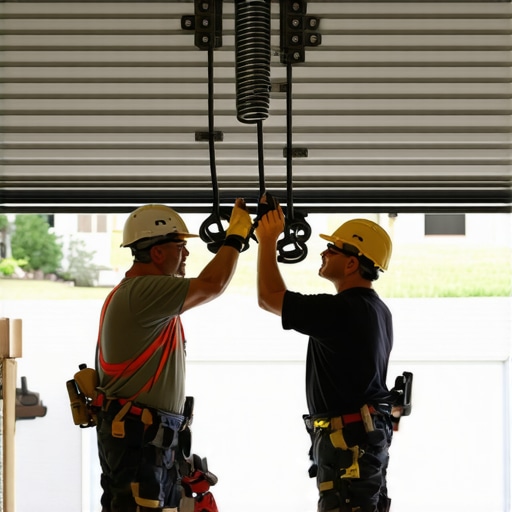
Torsion springs are under an immense amount of tension. Research into garage door accidents shows that a snapping spring or a slipping winding bar can exert enough force to be lethal. This is why professional technicians use specific winding patterns and high-grade steel winding bars. We also follow the rule of “replacing in pairs.” If you have a two-spring system and one breaks, the other is likely days or weeks away from the same fate. Replacing only one is a safety hazard because the tension will be uneven, causing the door to rack and potentially fall out of the tracks.
The precision required here is immense. I often compare the tension management in a garage door to structural engineering. Just as there is The Specific Rebar Pattern That Passes Foundation Inspections Fast, there is a specific winding count for every quarter-inch of spring wire. If the math is wrong, the safety of the entire system is compromised.
V. Cables, Rollers, and Tracks: The Supporting Safety Cast
While the springs and the motor get all the attention, the hardware is what keeps the door from falling on your car – or worse. A common emergency garage door repair involves a door that has come “off-track.” This usually happens when a cable snaps or a roller pops out of the guide.
The safety rule here is non-negotiable: a technician from bayareagaragedoorrepairinc.com must perform a full off-track repair and inspection before the opener is ever re-engaged. If you try to force a door that is off-track using the motor, you will likely burn out the gears or pull the tracks off the wall. We also focus heavily on garage door cable repair. These cables are the tendons of the door. Over time, the salty air in the Bay Area can cause these galvanized steel cables to fray and corrode.
When we perform a roller repair, we aren’t just looking for smooth movement. We are looking for “slop” in the bearings. If a roller seizes, it creates friction that can cause the door to “jump” and trigger the safety sensors, or in a worst-case scenario, cause the door to bind and collapse. This level of detail is why it is so important to know How to Verify a Subcontractor’s Insurance Coverage. Working with high-tension springs and heavy doors is high-risk work; you want a pro who is insured and follows every safety protocol to the letter.
VI. Commercial vs. Residential Safety Standards
It is also worth noting that safety rules differ when we move into commercial garage door repair. Commercial doors are often much larger and heavier, and they are used much more frequently than residential doors. Because of this, the safety mechanisms are different.
In many commercial settings, if photo-eyes cannot be installed due to the environment (like a high-moisture wash bay), the law requires a “constant-pressure-to-close” switch. This means the operator must physically hold the button down until the door is fully closed, ensuring they are watching for obstructions. This is a crucial distinction. Just as there is The Egress Rule for Basements That Don’t Have Bedrooms, safety codes for garage doors change based on the occupancy and usage of the building. A warehouse in San Jose has different safety requirements than a single-family home in Burlingame, but the goal – preventing injury – remains the same.
VII. Conclusion: Why Safety Rules Matter for Your Bay Area Home
When you are facing a garage door emergency, it is easy to get frustrated by “rules” and “codes.” It might feel like a technician is trying to up-sell you when they mention SB-969 or UL 325. But as someone who has seen the aftermath of failed safety systems, I can tell you that these rules are written in the interest of your family’s protection. They are designed to prevent entrapment, ensure egress during a power outage, and keep a 400-pound door from becoming a hazard.
If you have a bay area garage doors emergency, don’t attempt a DIY fix that could lead to injury or a code violation. Contact the experts at bayareagaragedoorrepairinc.com for a code-compliant garage door repair bay area. We pride ourselves on being the most safety-conscious technicians in the region, ensuring that your door is not just fixed, but safe for years to come.